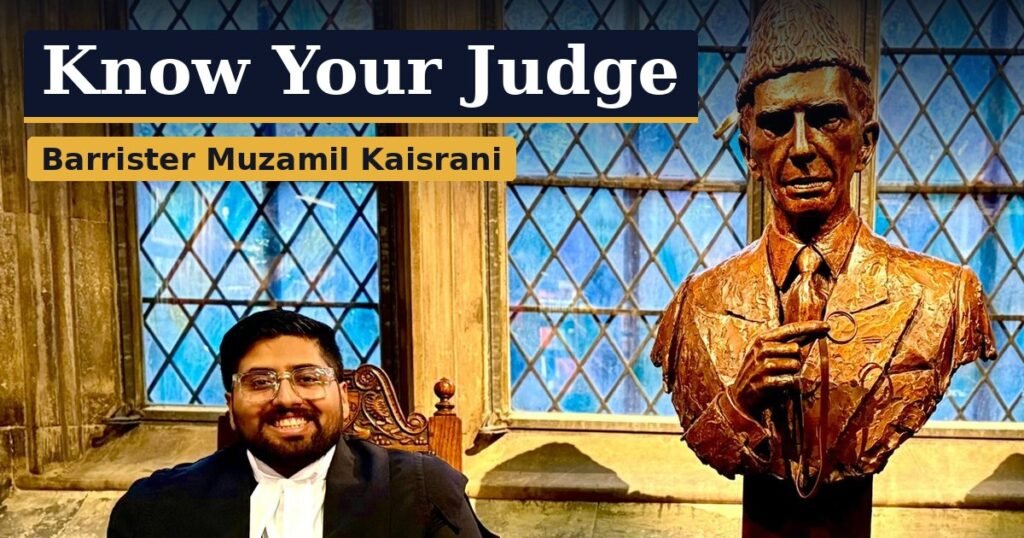
Know Your Judge: Courtroom Advice by Barrister Muzamil Kaisrani
Introduction
Early in my career, I attended a lecture given by a judge to a room full of lawyers. His advice was simple and has stayed with me ever since: you must know the judge before you enter the courtroom. It is not enough to know the law. You must also understand the person who will apply it.
Study the Judge Before the Hearing
A good advocate prepares a complete picture of the courtroom. That means reading the judge’s earlier judgments, noting the authorities he or she tends to rely on, and understanding which arguments are welcomed and which are not.
Before I appeared in a matter before the Honourable Justice Aalia Neelum of the Lahore High Court, I attended court the day before my hearing. I listened carefully to the bench. I observed which submissions the judge appreciated and how the courtroom responded to counsel. I also watched how senior members of the Bar conducted themselves. One of them arrived on time and was professionally dressed, and habits like these explain how far he has come in his profession.
Then it was my turn. Because I had watched and listened, I was not walking into unfamiliar territory.
You Will Have Very Little Time
Months or weeks of preparation can come down to a very short window. In most hearings, you will have two to three minutes. With some luck, you may reach five or six. If the judge is willing to engage in a proper exchange, you might reach ten minutes, but that is the ceiling, not the norm.
Most of the time, you will have a brief conversation with the judge and a short exchange with the opposing side. It is your responsibility to make that moment count. Every argument must be sharp, every authority must be ready, and every sentence must serve a purpose.
Be Careful Whom You Work With
Your senior is not only your teacher. Their reputation, perception and ideology often become attached to you. Before joining a chambers, ask yourself:
- How does this person lead?
- How do they engage with junior colleagues?
- Will they serve my long term professional interests?
The answers matter more than most young lawyers realise.
The Financial Reality of the Profession
I would be dishonest if I did not speak plainly about money. Most of us in this profession struggle to earn a steady income, especially in the early years. Clients who are willing to pay well are fewer than before, and competition is intense. Almost anywhere you look, someone is offering the same service at a lower fee.
Large companies and multinationals usually place their work with lawyers who have served for two decades or more and have built a name. New entrants rarely receive those briefs at the start.
What Early Cases Look Like
Initial work is usually modest: bail matters, stay applications, interim applications, suits for recovery, and cases involving injuries or theft. Prosecutions under the Control of Narcotic Substances Act, 1997 (CNSA), often brought by the Anti-Narcotics Force (ANF), also come to young lawyers, usually as bail or defence work.
High value matters, such as those involving the Federal Board of Revenue (FBR) or the National Electric Power Regulatory Authority (NEPRA), come rarely to a junior lawyer. That is not a reason for discouragement. Early cases teach you procedure, build your reputation, and prepare you for larger work.
Frequently Asked Questions
Why should a lawyer study the judge before a hearing?
Judges differ in temperament, preferences and reasoning. Reading their earlier judgments helps you frame arguments in a way that is likely to be heard.
How long will I really have to argue my case?
Often two to four minutes. Ten minutes is rare. Prepare as though every minute is precious.
Is it worth attending court the day before my hearing?
Yes. It lets you observe the bench, the pace of the cause list and the mood of the courtroom.
Does my choice of senior really matter?
It does. Their reputation and approach will shape how others see you and how quickly you grow.
What cases should a young lawyer expect at first?
Mostly bail applications, stay applications, interim relief, recovery suits and narcotics matters under the CNSA.
Who prosecutes narcotics cases under the CNSA?
In many cases, the Anti-Narcotics Force (ANF).
Can a new lawyer earn well in this profession?
It is difficult at the beginning. Patience, reputation and consistent quality of work are what eventually bring better instructions.
About the Author
Barrister Muzamil Kaisrani is a Barrister-at-Law of the Honourable Society of Lincoln’s Inn, London, and was Called to the Bar with Distinction. He is also a registered Advocate with the Punjab Bar Council.
He holds an LLM in Criminal Law and Family Law from the University of the West of England, Bristol, and an LLB from the University of London. He leads Kaisrani Law Associates in Lahore, where he practises in civil, criminal, corporate and family law.
He has also completed professional training in International Commercial Arbitration and Arbitration Advocacy.
Alongside legal practice, Barrister Muzamil Kaisrani has worked as a law lecturer, teaching Contract Law, Criminal Law, Constitutional Law and Legal Skills.
Related Articles