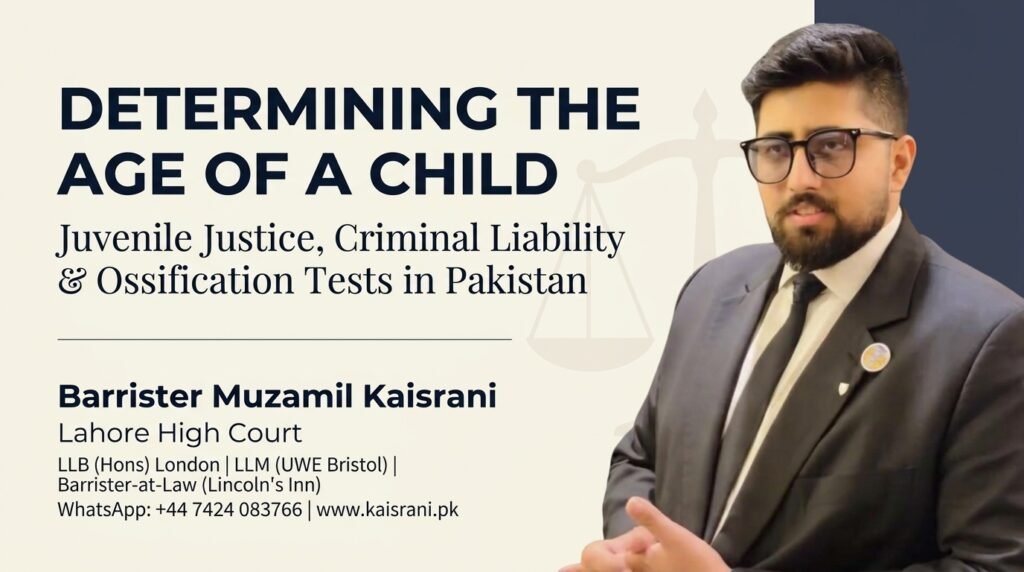
Marking Children’s Day on November 20, 2026, Barrister Muzamil Kaisrani addresses a practical question that carries serious consequences in criminal cases across Pakistan: how does the law decide a child’s exact age, and why does that single finding shape the entire trial?
In his video address on determining the age of children, he walks through the legal rules that separate children from adult offenders and prevent young people from being tried in the wrong forum.
Defining a Child and a Juvenile Under the 2018 Law
Pakistani law draws a clear boundary between children and adults in criminal proceedings through the Juvenile Justice System Act 2018:
-
Section 2(b) — Child: Any person who has not yet turned 18 years old.
-
Section 2(h) — Juvenile: A child who may be dealt with for an offence separately from an adult under the protective procedures set out in the Act.
Treating a juvenile separately from an adult is not a technicality. It ensures the court uses protective safeguards and focuses on rehabilitation rather than standard adult punishment.
Criminal Responsibility and the Burden of Proof
A child’s age directly affects whether they can be held criminally responsible under the Pakistan Penal Code, 1860:
-
Under Age 7 (Section 82): A child below seven years of age cannot be held criminally liable for any offence.
-
Ages 7 to 12 (Section 83): Liability depends on whether the child had enough maturity of understanding to judge the nature and consequences of their actions at the time. As Barrister Muzamil Kaisrani emphasizes, the burden falls squarely on the prosecution to prove that maturity before a child can be found guilty.
The Court’s Duty and Official Records
Under Section 8(1) of the Juvenile Justice System Act 2018, whenever someone claims to be a juvenile or appears to be one, the trial court is duty-bound to inquire into and establish their age before proceeding.
In real cases, disputes often arise when someone claims to be much younger than what official paperwork shows; for instance, claiming to be seven when records indicate they are eleven. Official documents issued by NADRA; such as a birth certificate, Family Registration Certificate (FRC), or national identity record—carry strong legal weight. Setting aside NADRA records in favor of a matriculation certificate or witness testimony requires a very high standard of proof.
When Documents Disagree: The Ossification Test
Contradictions between NADRA registration records and school or matriculation certificates are common. When official documents conflict or leave genuine doubt about a young person’s age, courts turn to medical evidence.
In these situations, an ossification test is ordered. This medical examination checks bone development to estimate the child’s biological age, giving the court an objective basis to decide whether the person falls under juvenile protection or adult criminal liability.
A Message to Young Citizens
Beyond statutes and courtroom procedure, Barrister Muzamil Kaisrani ends his message with straightforward advice for young people: learn your legal rights, stand up against oppression, never oppress others, and hold onto truth and justice as you grow into responsible citizens.
Frequently Asked Questions
Who is legally a child under the Juvenile Justice System Act 2018?
Under Section 2(b) of the Act, anyone under 18 years of age is legally defined as a child.
How does the law distinguish between a child and a juvenile?
Section 2(b) defines a child strictly by age (under 18), while Section 2(h) defines a juvenile in the context of criminal allegations—a child who must be tried and handled separately from adults under the Act.
Who must prove whether a 7-to-12-year-old understood their actions?
Under Section 83 of the Pakistan Penal Code, the prosecution carries the burden of proving that a child between seven and twelve had sufficient maturity to understand the nature and consequences of what they did.
What happens if NADRA records and a matric certificate show different ages?
Courts require strong evidence to override official NADRA records. If documents contradict one another and age remains uncertain, a medical ossification test is used to help establish the child’s age.
About the Author
Barrister Muzamil Kaisrani is a Barrister-at-Law (Honourable Society of Lincoln’s Inn) and Advocate practising in Lahore, Pakistan, including before the Lahore High Court and at Voice of Justice, while leading Kaisrani Law Associates. He holds an LLB from the University of London and an LLM in Criminal Law and Family Law from the University of the West of England, Bristol, and regularly shares practical legal guidance on his YouTube channel.
Related Articles