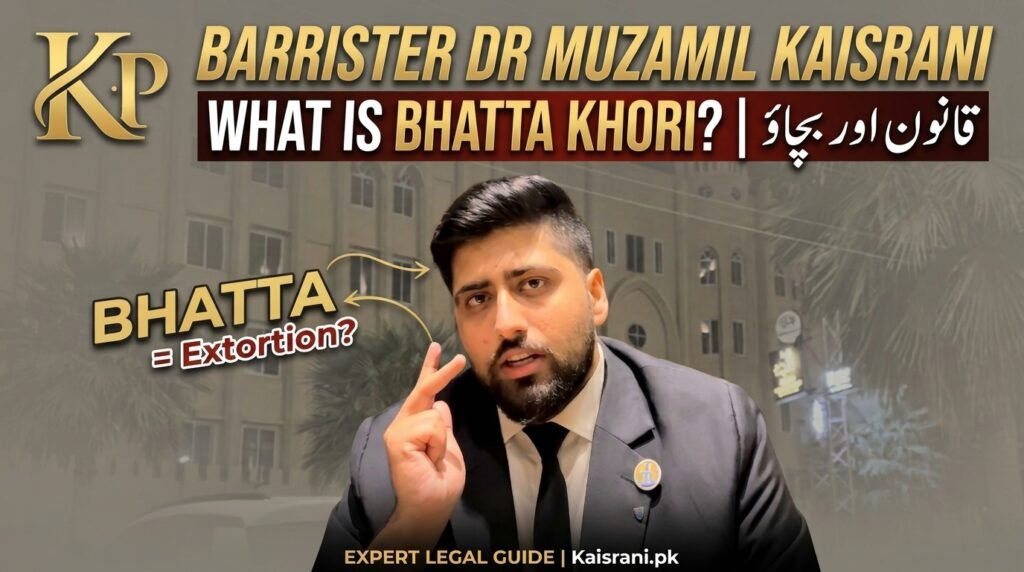
Core Legal Requirements Under Section 383 PPC
To establish extortion under Section 383 PPC in a Pakistani court, three essential legal elements must be proven together:
-
Fear of Unlawful Harm: The perpetrator must intentionally place the victim in fear of injury. Under Section 44 PPC, “injury” includes any harm unlawfully caused to a person’s body, mind, reputation, or property. Threatening legal actions—such as lodging an official police complaint or filing a petition in court—is lawful and does not meet this threshold.
-
Intentional Coercion: The threat must be actively used to force the victim to surrender property, money, or a signed valuable document.
-
Delivery of Asset: The victim must physically or constructively deliver the property as a direct consequence of the fear induced.
Case Study: Domestic Coercion and Property Surrender
Barrister Kaisrani illustrates these principles with a case handled by Kaisrani Law Associates, demonstrating how extortion occurs within family structures:
-
The Incident: A married woman was pressured by her in-laws to retrieve and hand over her bridal gold jewelry stored in a bank locker.
-
The Threat: The in-laws threatened to permanently expel her from the matrimonial home if she refused to surrender her property.
-
Legal and Social Impact: In Pakistan, forcing a woman out of her matrimonial home inflicts severe social stigma, emotional distress, and harm to her dignity. Because this threat was illegal and directly compelled the delivery of the gold ornaments, the elements of Section 383 PPC were established, allowing for the registration of an FIR with the Punjab Police.
Statutory Penalties Under the Penal Code
-
Section 384 PPC: Punishes basic extortion with imprisonment extending up to three years, a fine, or both.
-
Section 386 PPC: Applies when extortion involves threats of death or grievous hurt, carrying severe criminal penalties.
-
Common Examples: Extorting protection money from business owners under threat of destroying their commercial property, and blackmailing an individual with reputational exposure unless financial silence money is paid.
Frequently Asked Questions (Q&A)
Q: How does extortion differ from theft and robbery in Pakistani criminal law?
A: Theft involves taking property without consent, while robbery relies on immediate physical violence. Extortion involves coercing victims through fear of injury to voluntarily surrender their property.
Q: Is threatening to file a lawsuit considered extortion?
A: No. Section 44 PPC specifies that fear must involve an unlawful act. Pursuing remedies through legal channels or reporting a crime to authorities is entirely lawful.
Q: What steps should victims of bhatta khori take?
A: Victims should document all evidence, including text messages, voice recordings, witness accounts, and bank records, before consulting criminal defense lawyers to initiate formal proceedings through the police or direct court complaints.
About the Author
Barrister Muzamil Kaisrani is a Barrister-at-Law of the Honourable Society of Lincoln’s Inn, London, and was Called to the Bar with Distinction. He is also a registered Advocate with the Punjab Bar Council.
Holding an LLM in Criminal Law and Family Law from the University of the West of England, Bristol, and an LLB from the University of London, he heads Kaisrani Law Associates in Lahore. He maintains an active practice in civil, criminal, corporate, and family law litigation across forums including the Lahore High Court. He has also served as a law lecturer teaching Contract Law, Criminal Law, Constitutional Law, and Legal Skills, alongside holding certifications in International Commercial Arbitration.
-
Office Locations: Serving clients with primary offices in Bahria Town, Lahore and near the Lahore High Court jurisdiction.
-
Official Website: Access legal guides, articles, and firm consultation services at www.kaisrani.pk.